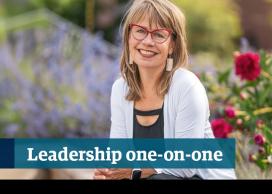
Dr. Jan Hare is Dean of the Faculty of Education, and provides overall academic and administrative leadership across both campuses in Vancouver and the Okanagan. She was appointed in 2024, after serving as the Faculty's Dean pro tem since 2021.
Dr. Hare holds a Tier 1 Canada Research Chair in Indigenous Pedagogy and serves as a Professor in the Department of Language & Literacy Education. Before becoming Dean, she led several key initiatives within the Faculty, including serving as Associate Dean for Indigenous Education and as the inaugural Professorship in Indigenous Education in Teacher Education.
As an Anishinaabe-kwe scholar and educator from the M’Chigeeng First Nation in northern Ontario, Dr. Hare brings a critical lens to long-standing colonial structures and champions the belief that education must transform to be more inclusive of Indigenous perspectives and community engagement. At the heart of her work is a deep commitment to Indigenous student success, from early literacy to graduate research, and every step in between.
Q1. What quality do you most admire in a leader?
JH: Relationality. I admire leaders who prioritize connection, not just with people, but with places, cultures, communities, and the land. A relational approach is dynamic, inclusive, and responsive. It invites different collectives to shape how we lead and helps advance goals like decolonization and reconciliation. I believe that leadership should focus on a more holistic view and see connections to places where we live and learn.
Q2. What makes you laugh?
JH: I have such appreciation for Indigenous comedy. My mum used to say Indigenous people are funny because we had to be — it was a survival mechanism. It’s a humour that’s both transformative and healing, helping us confront dark moments with absurdity. You see it in the brilliance of Dead Dog Café or Reservation Dogs, or Don Burnstick. I just love that laughter can bring people together across time and cultures.
Q3. Who inspires you, and why?
JH: I’ve been guided by many Indigenous mentors over the years, including my father. He was a conduit to the landscape of leadership for me. We would spend time driving about Manitoulin Island, in northern Ontario, where he would stop at places to share with me his knowledge and history of place. Other times, he would narrate for me accounts of Indigenous resistance and resurgence, stopping his truck at places to explain Anishinaabe response and opportunities presented to the community that were a result of incursion of Indigenous lands and rights. A good part of my leadership can be traced to the paths we travelled in those car rides. Our mapping exercises together were more than locating the geography around us. On reflection, I appreciate his intentional and constant return to story these places as a form of pedagogy that ensured my responsibilities towards Indigenous futures, wherever life took me.
There are also many Indigenous leaders across the country (among them, fellow UBC leaders like Jo-ann Archibald, Verna Kirkness, and Larry Grant) that have guided me in significant ways. They gift me with their stories grounded in their teachings, experiences, and living lives dedicated to the advancement of Indigenous people. I’m inspired by their courage, determination, and wisdom. Their stories open up spaces for me to contemplate and reflect on my own leadership practices. However, the making of meaning – the learning – that comes from those conversations, is always generative, unfolding over time and in different leadership roles I’ve held.
Q4. For you, what makes UBC different?
JH: Where I think UBC is really poised to make a difference is in its recognition of Indigenous peoples’ rights to determine their own educational futures. This goes beyond valuing relationships with Indigenous communities. It’s about restructuring relationships of power to support Indigenous self-determination. Innovative educational programs like NITEP and the new Ts’kel doctoral pathway in the Faculty of Education center Indigenous knowledge, ground themselves in community partnerships, and support research done in service to community. They reflect a shift in how knowledge is held, shared, and valued across the university.
These efforts speak to a deeper commitment to Indigenous citizenship, nationhood, and the transformation of educational systems. They’re also helping redefine what meaningful leadership and learning can look like at UBC.
Q5. What is the most important lesson you’ve learned in your career to date?
JH: The most important lesson I’ve learned is to take time. Leadership so often demands urgency. It might be urgency in decision-making or deadlines, but slowing down matters. Taking time to listen, to reflect, to consider different perspectives. I often remind myself of the White Rabbit’s words from Lewis Carroll’s Alice in Wonderland: “The hurrier I go, the behinder I get.” I’ve learned that when I take the time, I show up more fully, for others, and for myself. That care and attention doesn’t go unnoticed.
Q6. How do you like to recharge?
JH: Walking has become one of the most important ways I recharge. Sometimes it’s just a quick loop around campus—down the stairs, across the way to check in with colleagues, maybe a spontaneous visit to the Teacher Education Office or other units. Those small moments of movement and connection help shift my energy.
After the pandemic, I started something I call “tea at 3” on Sundays. It’s not really about the tea, it’s a way to be intentional about connection. I’ll reach out to someone, we’ll grab a tea or coffee, and go for a walk. Sometimes it’s someone I haven’t seen in years. Sometimes it’s just a quiet conversation to catch up. That unstructured time (often offline and outdoors) gives me space to think, reflect, and just be with people.
Q7. What is the best advice you were ever given?
JH: Consult, consult, consult. A former colleague said it to me once, and I’ve never forgotten it. Taking time to seek out other perspectives has shaped how I lead, especially before making a big decision. It also helps to surface fresh ideas, it makes people feel valued, and it reminds me that leadership isn’t something we do alone. For me, it can help bring transparency to my decision-making, reduce hierarchies, as well as anticipate or even navigate unanticipated points of resistance.
Q8. What do you value in your colleagues?
JH: I really value the spirit of generosity that my colleagues bring to their work, as leaders, scholars, or staff. You see it in so many forms, such as in the passion they bring to teaching and learning, in the compassion they show others in day-to-day interactions, and in the expertise they so willingly share through their research and leadership. We all feel valued in someone’s generosity of time, care, and presence.
Q9. What do you hope will be your lasting impact at UBC?
JH: I wanted to step outside of Indigenous leadership roles and bring other ways of knowing to the mission of the university. I’ve been deeply committed to advancing UBC’s institutional frameworks, especially the Indigenous Strategic Plan, the Strategic Equity and Anti-Racism Framework, and the Sustainability Plan. These directives are central to the mission of the university, especially as we look to reimagine how teaching, research, student support, faculty relations, and governance can be shaped by Indigenous perspectives and knowledges. I hope my work has helped bring those ideas to life in practical, visible ways—and that more Indigenous members of our university community will feel encouraged to step into leadership roles to carry this work forward.
At the same time, I’m aware of the precarity of practicing Indigenous leadership approaches in colonial spaces. Stepping in to the role of Dean, I was aware that some might assume I would focus exclusively on Indigenous matters rather than being seen as capable of engaging in the many spaces of the university and through various approaches to leadership while continuing to be authentically Indigenous. Indigenous leaders bring value across the institution—in every area of academic life, not just those explicitly tied to Indigeneity. Part of what I’ve tried to do is model that leadership can be informed by Indigenous ways of thinking and being, while also contributing across the university. I want to create spaces where others feel empowered to step in, and where Indigenous leadership is recognized as vital to all aspects of UBC’s future.
Q10. You’ve long been a proponent of transforming education to be more inclusive of Indigenous perspectives – what does decolonizing education mean to you in practice, and how is that vision being realized within your Faculty?
JH: To me, decolonizing education begins with recognizing that there are many ways of knowing and being in the world. To transform education, we need to disrupt colonial structures. Within our Faculty, that work includes creating intentional and sustained opportunities for faculty, staff, and students to engage with Indigenous knowledges – not as an optional ‘add-on’, but as an essential part of learning and scholarship. All students should encounter Indigenous histories, perspectives, and worldviews in their studies.
An important part of this work is self-reflection. Understanding Indigenous knowledge systems also means examining how we’ve each been taught to think about Indigenous-settler histories and how those teachings shape our relationships, our assumptions, and even our values. We all come into this work having been socialized into particular narratives. Decolonizing education asks us to question where those ideas come from, who they serve, and who they leave out or harm. And then begins the process of unlearning and relearning by listening to Indigenous perspectives, and on Indigenous terms.
Q11. What is your vision for the Faculty of Education, and what new directions or priorities are you hoping to bring forward?
JH: As a Faculty, we’re focused on preparing practitioners and leaders through a full spectrum of programming across teacher and professional education, as well as a wide range of programs in kinesiology and psychology. As a result of everyone’s efforts in the Faculty, we consistently rank as one of the top Faculties of Education nationally and among the top 50 globally. What also excites me about the immediate future of the Faculty of Education is that after much consultation, we’re developing a new Faculty Strategic Plan that will be ready for implementation in January. It’ll provide direction for building on what we already do well, such as flexible and innovative teaching, impactful research, and community engagement. Yet it will also give us abundant opportunities to surface the creative, collaborative, and community-rooted work that has long been the mark of our commitments to social justice and social change.
One of my priorities is creating more opportunities for people to work together across different areas, disciplines, teaching styles, and ways of thinking. These intersections are where some of our most meaningful insights can take shape. When we bring together different knowledge systems and methodologies for our work and learning, we open the door to new ways of seeing and understanding the world around us.
I’m also thinking about how we can strengthen the ties that hold our Faculty together, especially across geography. The UBC Okanagan School of Education offers a strong example of what it means to be rooted in place. Its relationships with the Syilx Nation and the Okanagan Indigenous Alliance are not transactional — they are relationships of reciprocity, built over time and carried with care. There’s a rhythm and respect in that way of working, and I believe we have much to learn from it as we move forward together.
Published: September 8, 2025
Interviewed by: Rivka Parris, UBC Internal Communications